Accelerate NHS reimbursement with intelligent clinical coding.

CareCoder AI is a clinical coding automation platform for NHS trusts, primary care and public health. It turns referral letters, discharge summaries, diagnostic reports and clinical notes into structured data, with ICD-10 coding, risk stratification and tariff outputs, so reimbursement moves faster and clinicians spend less time on data entry. Your coders confirm every code before it is submitted.

A member of hospital staff reviewing coded episodes on a tablet
CareCoder AINew document
Discharge summaryTrauma and orthopaedics
Diagnosis
Displaced intracapsular fracture of the left neck of femur.
Past medical history
Hypertension, well controlled.
Procedure
Cemented hemiarthroplasty, left hip, day 2.
  1. S72.0Fracture of neck of femurPrimary diagnosis, ICD-10
  2. I10Essential (primary) hypertensionSecondary diagnosis, ICD-10
  3. W46.1Primary prosthetic replacement of head of femur using cementProcedure, OPCS-4
  4. Z94.3Left sided operationLaterality, OPCS-4
Ready for review

Example with made-up patient details.

A clinical coder working through episodes on a laptop

Supporting healthcare through better clinical coding

By combining AI-driven automation with coding expertise, CareCoder AI helps trusts and providers meet their data quality obligations, maintain compliance and focus their skilled people where they add the most value.

It works with any document format, is purpose-built for healthcare workflows, and fits around the systems your team already uses.

How a document becomes a coded episode

CareCoder AI sits between the records your trust already keeps and national submission. It prepares, reads, codes and validates each episode, then sends it on via CDS to NHS England.

From your trust

Activity data from PAS
Clinical progress notes
Theatre and other systems
Discharge summaries
  1. Pre-process
  2. OCR
  3. Clinical language
  4. ICD-10 and OPCS-4
  5. Validate
  6. Submit via CDS

A discharge summary arrives

Fractured neck of femur, cemented hemiarthroplasty of the left hip.

NHS England

Starts with what your trust already hasActivity data from your PAS, clinical progress notes, theatre records, discharge summaries and letters, in any format.

Fits the systems around itBegins from document extracts, with no EPR or PAS integration needed to start. Exports in CSV, JSON and NHS formats for your reporting and finance systems.

Why CareCoder AI

Routine episodes arrive drafted and evidenced, so experienced coders can give their time to complex cases, clinical queries and data quality.

  • Accelerate NHS reimbursement

    Keep the payment cycle moving by turning clinical documents into reimbursement-ready outputs automatically.

  • Coding accuracy and compliance

    Fewer manual errors, with outputs aligned to NHS standards and UK GDPR.

  • Less administrative burden

    Clinicians and back-office teams spend less time on manual data entry and more on the work that needs them.

  • Proven impact

    Less manual processing time, better data quality and consistency, and traceable outputs ready for audit.

What the platform handles

Six capabilities working from the same document, so the codes, the groupings and the evidence always agree.

Document
Discharge summary
Specialty
Trauma and orthopaedics
Diagnosis
Fracture, left neck of femur
Procedure
Cemented hemiarthroplasty

Example with made-up patient details

Document capture and OCR

Scanned PDFs and images turned into structured, searchable text, ready for coding.

  • Scans, photos and digital letters
  • Layout and tables kept intact
  • Every field traceable to the page
A coder reviewing coded activity at a desktop

Every code, traced to its source

Each drafted code links to the passage it came from, with a confidence score. Coders confirm it, change it with a reason or raise a query with the clinical team, all in one place.

Source linked
The passage behind every code is one click away.
Confidence shown
Each suggestion is scored, so effort goes where it is needed.
Audit ready
Every change is attributed and kept for coding audit.

Ready for your IG and clinical safety review

UK hosting

UK-only hosting on AWS, with a dedicated tenant for each trust.

Data protection

UK GDPR and Data Protection Act 2018 compliant, with role-based access and every action logged.

Clinical safety

DCB0129 safety case and DTAC pack prepared, ahead of your DCB0160 review.

Assurance

DSPT submission, a trust-specific DPIA and data sharing agreement completed before any live data is used.

Cyber Essentials certifiedCyber Essentials certified

About CareCoder AI

CareCoder AI brings Origin’s evidence-first approach to clinical coding, so every code an NHS trust submits can be traced back to the record.

Shaped with healthcare providers and experienced clinical coders, and proven in pilot programmes across multiple activity cohorts, CareCoder AI helps organisations strengthen coding performance, reduce backlogs and keep pace with national reporting. It is built by the same team behind connects.health. Visit Origin Care Group

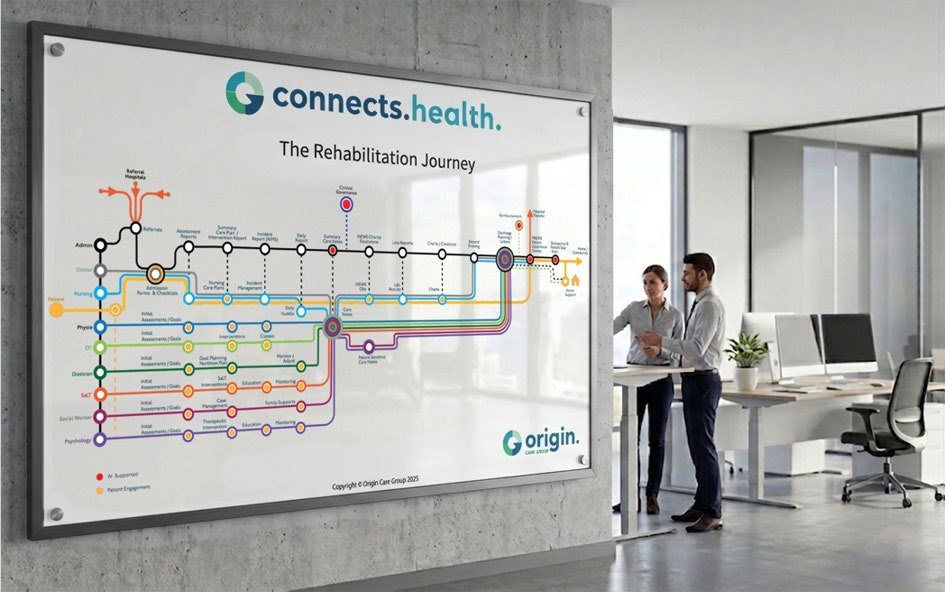
The team reviewing a care pathway map in the Origin Care Group office

From connected people to connected care.

CareCoder AI is part of Origin Care Group. Origin began in 2016 with an age-friendly tablet co-designed with older adults, and each stage since has built on the one before.

Connecting people

We began with the person: an age-friendly tablet, co-designed with older adults, that proved people will use technology built around them.

  • Co-designed with older adults
  • Adopted through libraries and local authorities
  • Family connection at its heart

Proving it in clinical care

Live in HIQA-regulated and HSE clinical settings, with independent recognition as an Irish Healthcare Awards winner.

  • Live in regulated clinical settings
  • Irish Healthcare Awards winner
  • Sláintecare-funded community work

Building the platform

connects.health launched, with referrals, beds, care plans, governance and reporting on one record, built around what our customers asked for.

  • One record across the pathway
  • Assessments, care plans and MDT
  • Governance built in

Scaling across the continuum

Deployed at national scale across hospital, step-down, residential and community settings, with leading healthcare providers.

  • National-scale deployment
  • Step-down and rehabilitation growth
  • Serving the UK and Ireland

Adding intelligence

CareCoder AI launches for NHS trusts and clinical coding teams, and Insights enters deployment in connects.health. Both bring forward what needs attention, with the source attached.

  • CareCoder AI for the NHS
  • Insights in deployment
  • Self-hosted, source-first AI

Meet the people behind CareCoder AI

Meet the team

Built by people who have done this before.

Engineers, clinicians and board-level operators with deep experience in regulated care and technology.

Management team

Our management team across technology, finance, marketing and operations.

  • Philip Hogan

    Philip Hogan

    Chief Executive and Founder

    Philip has over 28 years of experience in the ICT sector, leading global sales, marketing and engineering services teams. He holds a number of non-executive advisory and board seats in the telecoms, education and medtech industries.

  • Frank McGuinness

    Frank McGuinness

    Chief Technology Officer

    A seasoned CTO, IT architect and developer with over two decades designing and leading technology solutions for large multinational organisations. Frank’s expertise spans integration architecture, API management and health data exchange standards, including HL7 and FHIR.

  • Niall Norton

    Niall Norton

    Acting Chief Financial Officer

    Previously CFO of O2, CEO of Openet and General Manager at Amdocs. Brings scale-up and exit experience to a company moving from product into platform.

  • Alison O’Sullivan

    Alison O’Sullivan

    Marketing Director

    Leads brand and go-to-market strategy for Origin Care Group, including CareCoder AI and connects.health. Alison also leads operations, including training and onboarding for new deployments.

  • Dr Pat Mulroy

    Dr Pat Mulroy

    Chief Solutions Architect

    Holds a PhD in Engineering. Pat designs the underlying clinical record and the integration layer: how our platforms exchange data with the systems a service already runs.

  • Lorenas Orleckas

    Lorenas Orleckas

    Senior Software Engineer

    Builds and develops our platforms, working closely with customers during deployments to make sure each one fits the way the service works.

Clinical advisory board

Practising clinicians and service leaders review what we build against the reality of running a service.

  • Prof. Dermot Power

    Consultant Geriatrician

    Brings the clinical view on older-adult care, rehabilitation pathways and what the platform should be measuring.

  • Dr Eamonn Brazil

    Clinical Director, Earlsfort Health

    Clinical leadership perspective on how services are actually run and governed day to day.

Board and advisers

The company is supported by people who have run and exited significant technology businesses, including senior finance and executive leadership from Ryanair, Openet and Amdocs.

Clinical insight
Clinicians who make sure every feature works in practice
Commercial experience
Operators who have scaled technology businesses
Technical depth
Architects with decades of experience in regulated systems

How we work

You work with the people who design, build and implement the platform. When something needs to change, the decision is made by someone already in the conversation.

Everything is built in Ireland by one team, so a change requested during a deployment reaches the people who own the roadmap directly.

Clinical review
Our clinical advisory board reviews what we build against practice
Alongside you
Engineers work alongside customers during deployments
One team
The same team across every product line

From connected people to connected care

Read our story

Articles and news

Guides and insight on clinical coding, reimbursement and data quality, plus the latest news and events from the CareCoder AI team.

Reviewing coded activity on a laptop

News and events

Where the team has been talking about AI in healthcare.

  • TechIreland National AI Meet 2026, 24 September, Galway

    Event24 September 2026, Galway

    Philip Hogan joins the panel at the TechIreland National AI Meet 2026

    Philip joined Mark Prendergast (Prendergast Leadership) and John Randles (Siren) for a panel on “The Urgency of AI Transformation”: what AI transformation really means for businesses today, and how leaders can move beyond talking about AI to delivering real impact.

  • Philip Hogan speaking to an audience at the Guinness Enterprise Centre

    EventSeptember 2026, Dublin

    Philip Hogan and Jerome Forde speak at the Guinness Enterprise Centre

    Philip Hogan, founder of Origin Care Group, joined Jerome Forde, founder and CEO of HR Duo, to talk about putting AI to work in a SaaS business, and how the team is using AI to deliver increasingly sophisticated solutions for healthcare providers across the UK and Ireland.

ArticlesReimbursement3 November 2026

Reducing uncoded activity: why it matters more than ever for NHS reimbursement

Uncoded activity has always been a challenge for NHS organisations, but today it carries far greater operational and financial consequences than ever before.

Working through figures on a phone calculator over paperwork

As Trusts face rising demand, workforce shortages, and increasing scrutiny over data quality, the volume of uncoded episodes can quickly snowball — delaying reimbursement, distorting performance metrics, and placing additional pressure on already stretched coding teams.

In an environment where every pound and every data point matters, reducing uncoded activity is no longer a “nice to have.” It’s a strategic imperative.

What is uncoded activity, and why does it happen?

Uncoded activity refers to clinical episodes that have been completed but not yet translated into structured, accurate clinical codes. These delays typically arise from:

  • High clinical documentation volumes
  • Staff shortages or sickness
  • Seasonal surges in activity
  • Complex cases requiring specialist coding expertise
  • Incomplete or inconsistent clinical documentation
  • Manual processes that simply can’t scale with demand

While some backlog is inevitable, sustained or growing uncoded activity creates significant downstream issues — especially for reimbursement.

The financial impact: delayed or inaccurate reimbursement

NHS reimbursement depends on timely, accurate coding. When episodes remain uncoded:

  • Payment is delayed, affecting cash flow and financial planning
  • Tariff values may be lower if coding is rushed or incomplete
  • Trusts risk under‑claiming for high‑complexity or high‑acuity care
  • Month‑end and year‑end reporting becomes more difficult
  • Commissioners receive incomplete activity data, impacting negotiations

In short: uncoded activity is not just an operational inconvenience — it’s a direct financial risk.

The data quality impact: incomplete or inaccurate reporting

Beyond reimbursement, uncoded activity undermines the accuracy of:

  • SUS submissions
  • National datasets
  • Performance dashboards
  • Clinical governance reporting
  • Population health analytics

When episodes sit uncoded, Trusts lose visibility into what care has been delivered, to whom, and at what level of complexity. This affects everything from service planning to quality improvement initiatives.

Why the pressure is increasing now

Several trends are making uncoded activity more urgent than ever:

  1. Rising activity levels. Emergency care, elective recovery, and SDEC expansion all contribute to higher documentation volumes.
  2. Workforce constraints. Coder recruitment and retention remain challenging, with many teams operating below establishment.
  3. More complex documentation. Longer, more detailed clinical narratives — especially in digital-first environments — take more time to interpret and code manually.
  4. Greater financial scrutiny. Trusts are under pressure to maximise revenue and demonstrate financial stability.
  5. The shift toward real-time data. Operational leaders increasingly expect same-day or next-day visibility of activity and acuity.

The result? Traditional manual coding workflows simply cannot keep pace.

How automation helps reduce uncoded activity

AI‑enabled clinical coding automation offers a scalable, reliable way to reduce uncoded activity without increasing coder workload. Platforms like CareCoder AI support Trusts by:

Processing documentation in real time

Referral letters, discharge summaries, and diagnostic reports can be coded as soon as they are completed.

Reducing manual effort

AI handles the initial coding pass, allowing coders to focus on validation and complex cases.

Improving completeness and accuracy

Automation identifies missing clinical detail and ensures codes reflect the full clinical picture.

Supporting workforce sustainability

Coders spend less time on repetitive tasks and more time on specialist work.

Preventing backlog growth

Even during surges, automation keeps activity flowing through the coding pipeline.

The outcome is a more stable, predictable, and resilient coding function.

The strategic benefits for NHS Trusts

Reducing uncoded activity delivers measurable improvements across the entire organisation, strengthening both operational and financial performance. Trusts benefit from faster reimbursement and improved cash flow, alongside higher coding accuracy that supports better tariff optimisation. With more complete and timely coding, leaders gain clearer visibility of operational performance and more reliable data for planning, governance, and decision‑making. Coding teams experience reduced pressure as backlogs shrink, while finance and information teams gain greater confidence in month‑end and year‑end reporting. In a system where margins are tight and demand continues to rise, these improvements are genuinely transformative.

A future where uncoded activity doesn’t hold Trusts back

The NHS is moving toward a world where real‑time data, automation, and intelligent workflows are essential to operational success. Reducing uncoded activity is a critical step in that journey — and AI‑enabled coding is one of the most effective tools available to Trusts today. By combining the expertise of clinical coders with the speed and consistency of automation with tools such as CareCoder AI, organisations can ensure that every episode is coded accurately, promptly, and in full — unlocking the financial and operational benefits that follow.

ArticlesOperations15 September 2026

How AI automates healthcare’s unseen administrative burden

Why healthcare needs intelligent automation that supports clinicians, coders, and operational teams alike.

Working through records on a laptop

Healthcare is powered by people — clinicians, coders, administrators, and operational teams who keep the system moving. But behind every patient encounter lies a vast, often invisible layer of administrative work. Clinical documentation must be interpreted, coded, validated, and transformed into structured data that supports reimbursement, reporting, and decision‑making.

This administrative layer is essential, but it is also one of the most time‑consuming and resource‑intensive parts of modern healthcare. As documentation volumes rise and workforce pressures intensify, organisations are searching for solutions that can reduce manual workload without compromising accuracy or compliance.

This is where CareCoder AI is making a meaningful impact. Purpose‑built for clinical environments, CareCoder AI automates the transformation of medical documents into structured data, delivering instant ICD‑10 coding, risk stratification, and reimbursement‑ready outputs. By doing so, it helps healthcare organisations reduce administrative burden, accelerate financial workflows, and support coding teams — all while keeping humans firmly in control.

Healthcare administration is complex and costly. Much of this cost stems from the intricate processes required to document care, translate clinical notes into billing codes, verify insurance coverage, submit claims, and ensure regulatory compliance.

Consider what happens after a routine patient encounter. A physician documents the visit in an electronic health record. A medical coder reviews that documentation, assigns appropriate diagnosis and procedure codes, and ensures the coding meets payer-specific requirements. A billing specialist prepares and submits claims. If the claim is denied, staff members investigate, resubmit, and follow up. Meanwhile, compliance officers audit random samples to ensure all coding meets regulatory standards. This administrative chain involves multiple handoffs, quality checks, and potential delays — all before the healthcare organisation receives payment for services rendered.

The administrative burden extends beyond billing. Healthcare organisations must maintain detailed records for quality reporting, track clinical outcomes for value-based care programmes, respond to payer audits, manage prior authorisations, coordinate care across multiple providers, and ensure compliance with evolving regulations. Each of these processes requires substantial human time and attention, pulling resources away from direct patient care.

Where CareCoder AI enters the picture

CareCoder AI addresses healthcare’s administrative burden by automating the most time-consuming and repetitive elements of medical coding and documentation management. The platform uses advanced artificial intelligence to read and interpret clinical documentation, identify relevant diagnoses and procedures, suggest appropriate codes, and flag potential issues before claims are submitted. Work that would take a coder considerable time on each chart is prepared far faster, while maintaining accuracy and compliance standards.

But CareCoder AI’s impact extends beyond simply coding faster. The system tackles multiple layers of administrative complexity simultaneously. It checks for documentation completeness, identifying gaps that could lead to claim denials. It applies payer-specific rules, ensuring codes meet the requirements of different insurance companies. It monitors for compliance issues, flagging potential audit risks before they become problems. It tracks coding patterns across an organisation, identifying opportunities for documentation improvement and revenue optimisation.

Automating the coding process

Medical coding represents one of healthcare’s most significant administrative bottlenecks. The process requires specialised knowledge, meticulous attention to detail, and constant updates as code sets and guidelines evolve. Healthcare organisations face persistent shortages of qualified medical coders, and training new coders takes months to years before they achieve proficiency.

CareCoder AI automates the most labour-intensive aspects of this process. The system ingests clinical documentation — physician notes, operative reports, diagnostic test results, nursing assessments — and uses natural language processing to extract clinically relevant information. It identifies diagnoses mentioned throughout the record, recognises procedures performed, notes complications and comorbidities, and understands the relationships between different clinical elements.

From this analysis, CareCoder AI generates appropriate code sets, applying the complex rules that govern medical coding. It knows that certain diagnoses require specific documentation elements to support higher-specificity codes. It understands sequencing rules that determine which diagnosis should be listed first. It recognises when procedure codes require modifiers to indicate unusual circumstances. It applies medical necessity criteria to ensure codes reflect clinically appropriate care.

For routine cases with straightforward documentation, CareCoder AI can produce complete, accurate code sets ready for claim submission. For complex cases or ambiguous documentation, the system highlights areas needing human review, ensuring that expert coders focus their time where it’s most valuable. This tiered approach maximises efficiency while maintaining quality and compliance.

Reducing claim denials and rework

Claim denials represent a massive hidden cost in healthcare administration. Each denied claim takes staff time and triggers a cascade of administrative work: identifying the denial reason, determining the correction needed, gathering additional documentation if required, resubmitting the claim, and following up to ensure payment.

CareCoder AI significantly reduces denials by catching issues before claims leave the organisation. The system applies payer-specific edits, checking whether proposed code combinations will trigger automatic rejections. It verifies that documentation supports the level of service billed. It ensures required modifiers are present. It checks for common errors like mismatched diagnoses and procedures or missing secondary diagnoses that affect reimbursement.

By identifying these issues proactively, CareCoder AI prevents the costly cycle of denial and rework. Claims are cleaner when initially submitted, leading to faster payment, reduced days in accounts receivable, and less staff time spent on claim follow-up. The administrative burden shifts from reactive problem-solving to proactive quality assurance.

Supporting compliance and audit readiness

Healthcare compliance represents another significant administrative burden. Organisations must conduct regular audits of their coding practices, respond to payer audits, and ensure their coding aligns with constantly evolving regulations. Compliance staff spend countless hours reviewing charts, comparing documentation to codes assigned, and identifying potential risks.

Despite their best efforts, even experienced coders working under time pressure can miss critical details — overlooking a required modifier, failing to catch conflicting code combinations, or not noticing documentation that doesn’t support the codes assigned. When coders rush through high volumes of charts, fatigue sets in and errors slip through. A coder might forget to verify that a diagnosis code aligns with the patient’s age or gender, miss that a procedure requires additional documentation of medical necessity, or inadvertently code services at a higher complexity level than documentation supports. These seemingly small oversights can trigger compliance violations, costly audits, and even allegations of fraud. The problem isn’t incompetence — it’s the inherent limitation of human attention when processing thousands of codes across complex cases every day. CareCoder AI serves as a tireless compliance safeguard.

The tangible impact of reducing administrative burden

The benefits of automating healthcare’s administrative burden extend beyond cost savings, though those are significant. When CareCoder AI handles routine administrative tasks, healthcare organisations experience multiple positive effects.

Clinical staff spend less time on documentation and coding-related activities and more time on patient care. Revenue cycle teams process higher volumes of claims with greater accuracy and speed. Compliance risks decrease as potential issues are identified and addressed proactively. Days in accounts receivable decline as claims are paid faster. Staff satisfaction improves as employees focus on meaningful work rather than repetitive tasks.

Perhaps most importantly, the cognitive burden on healthcare professionals decreases. Physicians can document clinical encounters without constantly worrying about coding implications. Coders can focus their expertise on complex cases rather than drowning in routine work. Administrators can make strategic decisions based on real-time data rather than spending all their time managing operational details.

Looking forward: administrative transformation

CareCoder AI represents more than just an efficiency tool — it’s a fundamental reimagining of healthcare administration. The platform demonstrates that much of healthcare’s administrative burden, long considered an unavoidable cost of doing business, can be automated through intelligent application of artificial intelligence.

The unseen administrative burden that has long weighed down healthcare is finally being lifted, not by hiring more administrators, but by intelligently automating the processes that create that burden. CareCoder AI proves that healthcare can be more efficient, less costly, and more focused on patient care — all by addressing the work that happens behind the scenes, work that patients never see but that profoundly affects their care.

ArticlesCoding practice14 July 2026

The AI co-pilot for clinical coders: enhancing expertise, not replacing it

How CareCoder AI supports coding teams while keeping humans in control.

A clinician working at a ward workstation

The emergency department chart tells a complex story: an elderly patient presents with chest pain, has a history of diabetes and hypertension, receives multiple diagnostic tests, and is ultimately admitted for unstable angina. The documentation spans dozens of pages, references previous encounters, includes multiple provider notes, and contains clinical nuances that determine not just reimbursement but compliance and quality reporting. For a clinical coder, this represents exactly the kind of case where expertise matters most — and where AI co-pilot technology like CareCoder AI is proving transformative, not by replacing human judgement, but by enhancing it.

This article explores how AI co‑pilots like CareCoder AI strengthen coding workflows, improve financial performance, and empower coders to work at the top of their expertise.

Clinical coding has always been a profession that demands both breadth and depth of knowledge. Coders must maintain familiarity with thousands of ICD-10 diagnosis codes and OPCS-4 procedure codes, and the intricate guidelines that govern how these codes interact. They navigate documentation from multiple providers, interpret clinical terminology, and apply complex logic to arrive at accurate code assignments. It’s intellectually demanding work that directly impacts healthcare revenue, regulatory compliance, and data quality.

AI co-pilot technology like CareCoder AI enters this landscape not as a replacement but as a precision instrument that augments human capability. CareCoder AI analyses clinical documentation using advanced natural language processing, identifying key clinical concepts, flagging relevant diagnoses and procedures, and suggesting appropriate codes based on comprehensive guideline databases. But the crucial element — the one that defines this as “co-pilot” rather than “autopilot” — is that human expertise remains central to every coding decision.

Consider how this partnership functions in practice. When a coder opens a complex case in CareCoder AI, the system performs an initial analysis within seconds, highlighting clinical indicators throughout the documentation: mentions of chronic conditions, acute diagnoses, procedures performed, and complications noted. It surfaces relevant coding guidelines, alerts the coder to potential query opportunities where documentation may be incomplete, and suggests a preliminary code set. The human coder then applies their expertise: validating CareCoder AI’s suggestions, recognising clinical relationships the AI might miss, identifying documentation gaps that need clinician clarification, and exercising judgement on ambiguous situations.

Why clinical coders need an AI co‑pilot, not a replacement

Clinical coding is a highly skilled profession. Coders interpret complex clinical narratives, apply coding rules, ensure compliance, and maintain the accuracy that underpins reimbursement and reporting. Their expertise is irreplaceable.

But the workload has become overwhelming. Coders today face:

  • Increasing documentation complexity
  • Growing demand for coding specificity
  • Rising audit scrutiny
  • Tight reimbursement timelines
  • Persistent staffing shortages

CareCoder AI helps relieve this pressure by handling the repetitive, high‑volume tasks that slow coders down — while leaving humans firmly in control of final decisions.

What CareCoder AI actually does

CareCoder AI is not an autonomous coder. It is a support system that enhances human performance. It:

  • Converts referral letters, discharge summaries, diagnostic reports, and clinical notes into structured data
  • Generates instant ICD‑10 codes based on extracted clinical information
  • Produces risk stratification and tariff outputs to support reimbursement workflows
  • Reduces human error and supports compliance with NHS and GDPR standards
  • Accelerates reimbursement by removing bottlenecks in the payment cycle

These capabilities make CareCoder AI a powerful assistant — a co‑pilot — that helps coders work faster and more accurately. But the human coder remains the expert, reviewer, and final decision‑maker.

This division of labour is strategic. CareCoder AI handles computational tasks — scanning lengthy documents, cross-referencing thousands of codes, checking for basic conflicts — at speeds humans cannot match. The human coder focuses on higher-order cognitive tasks: clinical reasoning, contextual interpretation, quality assessment, and complex decision-making. The result is greater precision than either could achieve alone.

Efficiency that enables excellence

One of the most significant impacts of CareCoder AI is how it reshapes where coders invest their time and cognitive energy. Before AI assistance, even experienced coders spent substantial time on mechanical tasks: searching for codes in classification systems, reading through coding guidance to verify unusual code applications, and documenting the rationale for code selection. These tasks were necessary but didn’t fully use professional expertise.

CareCoder AI handles these mechanical elements efficiently, creating space for coders to focus on what truly requires human intelligence. A coder can review more routine cases in the same timeframe, not because they’re rushing but because CareCoder AI handles the groundwork. More importantly, they can invest additional time in complex cases that genuinely need deep expertise, cases they might have previously needed to process quickly due to volume pressures.

This efficiency gain doesn’t translate to “we need fewer coders.” Instead, it addresses the reality of growing coding demands: increasing patient volumes, expanding code sets, more detailed documentation requirements, and heightened compliance scrutiny. Healthcare organisations aren’t looking to reduce coding staff — they’re struggling to recruit and retain enough qualified coders to meet existing demands. CareCoder AI helps existing teams manage growing workloads while maintaining or improving quality.

The synergistic future of healthcare data management

Looking forward, the relationship between CareCoder AI and clinical coding expertise represents a model for healthcare data management more broadly. Healthcare generates massive amounts of data, and extracting accurate, meaningful information from this data requires both computational power and human intelligence. AI excels at pattern recognition, data processing, and information retrieval. Humans excel at contextual understanding, ethical judgement, and complex reasoning.

The synergy between these capabilities creates possibilities neither could achieve independently. CareCoder AI-enhanced coding can support more granular quality measurement, identify documentation improvement opportunities across entire organisations, and enable more sophisticated analysis of care patterns. Human coders, freed from routine tasks, can take on broader roles in data quality management, clinical documentation improvement, and healthcare analytics.

Empowering professionals for greater impact

The ultimate measure of CareCoder AI’s success isn’t how much work it can do without human involvement but how much it empowers coders to achieve. Early implementations are demonstrating this in measurable ways: improved coding accuracy, reduced claim denials due to coding errors, increased coder productivity on complex cases, enhanced compliance with evolving regulations, and better job satisfaction among coding professionals.

Conclusion

Clinical coding will always require the judgement, clinical understanding, and ethical reasoning that only humans provide. CareCoder AI simply ensures that this irreplaceable human expertise can be applied with greater precision, efficiency, and impact. That’s not replacement — it’s enhancement. And it’s exactly what healthcare needs.

ArticlesFinance12 May 2026

The ROI of coding automation: financial impact, turnaround time and accuracy

Why AI‑powered coding is becoming one of the highest‑value investments in global healthcare.

A clinician working through paperwork with a calculator

Across the world, healthcare organisations are under pressure to do more with less. Documentation volumes are rising, coding teams are stretched thin, reimbursement cycles are tightening, and accuracy expectations are increasing. In this environment, leaders are looking for solutions that deliver measurable operational and financial impact — not just incremental improvements.

Coding automation has emerged as one of the most powerful levers available. When implemented well, it improves accuracy, accelerates turnaround time, reduces backlogs, strengthens revenue integrity, and frees coding teams to focus on the work that truly requires human expertise.

But the question every executive eventually asks is simple: what is the real return on investment?

This article breaks down the ROI of coding automation across three critical dimensions — financial impact, turnaround time, and accuracy — and explores how platforms like CareCoder AI are helping organisations achieve meaningful, measurable results.

1. The financial impact

Financial performance is one of the clearest and most compelling ROI drivers for coding automation. Coding is directly tied to reimbursement, and delays or inaccuracies can have significant downstream effects.

Faster reimbursement cycles

Traditional coding workflows often create bottlenecks that slow down the entire revenue cycle. Backlogs, staffing shortages, and documentation complexity can delay coding by days or even weeks. Coding automation changes this dynamic by:

  • Processing routine cases instantly
  • Reducing manual workload
  • Enabling real‑time or near‑real‑time coding
  • Providing earlier visibility into activity and revenue

Platforms like CareCoder AI convert referral letters, discharge summaries, diagnostic reports, and therapy notes into structured ICD‑10 codes and reimbursement‑ready outputs straight away, giving finance teams faster insight into expected revenue and improving cash flow predictability.

Reduced denials and rework

Denials are one of the most expensive and preventable sources of revenue leakage. Many denials stem from:

  • Incomplete documentation
  • Incorrect or insufficient coding specificity
  • Missed secondary diagnoses
  • Inconsistent application of coding rules

AI‑supported coding helps reduce these issues by:

  • Applying coding logic consistently
  • Identifying missing clinical details
  • Capturing more specific codes
  • Highlighting documentation gaps before submission

Fewer denials mean fewer appeals, less rework, and more revenue captured on the first pass.

Lower operational costs

Hiring, training, and retaining experienced coders is increasingly challenging — and expensive. Automation helps organisations scale without proportional increases in headcount. This doesn’t replace coders; it optimises their time. With CareCoder AI handling high‑volume, routine cases, coding teams can focus on:

  • Complex cases
  • Quality assurance
  • Clinical documentation improvement
  • Audit preparation

This shift reduces overtime, lowers outsourcing costs, and improves overall productivity.

2. The turnaround time impact: from backlogs to real‑time coding

Turnaround time is one of the most visible and measurable indicators of operational performance. Long turnaround times create financial delays, operational blind spots, and increased pressure on coding teams.

Clearing backlogs

Backlogs are often caused by:

  • Staff shortages
  • Seasonal surges
  • High documentation volume
  • Complex clinical narratives

Automation helps organisations stay ahead of demand by processing large volumes of documents quickly and consistently. CareCoder AI, for example, can process referral letters, discharge summaries, diagnostic reports, and therapy notes straight away — turning what used to be days of work into seconds.

Enabling real‑time or near‑real‑time coding

Real‑time coding is no longer a future aspiration — it’s becoming a reality. When coding happens immediately after documentation is created, organisations gain:

  • Faster billing
  • Earlier identification of documentation gaps
  • More accurate forecasting
  • Better operational planning
  • Stronger clinician engagement

Real‑time coding also reduces the cognitive load on clinicians, who can respond to documentation queries while the encounter is still fresh.

Improving month‑end and year‑end cycles

Month‑end close is one of the most stressful periods for finance and coding teams. Backlogs, delays, and incomplete data can create uncertainty and last‑minute pressure. Automation stabilises these cycles by:

  • Reducing variability
  • Providing predictable throughput
  • Ensuring consistent coding volume
  • Delivering earlier financial visibility

This leads to smoother reporting cycles and more reliable financial performance.

3. The accuracy impact: better data, better decisions, better care

Accuracy is the foundation of coding. It affects reimbursement, reporting, quality metrics, and clinical governance. Even small variations can have significant consequences.

Reducing variation between coders

Human coders bring expertise — but also natural variation. Two coders may interpret the same document differently, especially when documentation is ambiguous. AI helps reduce this variation by:

  • Applying coding rules consistently
  • Identifying clinical concepts that may be overlooked
  • Ensuring specificity based on documentation
  • Supporting audit‑ready outputs

CareCoder AI is designed to extract structured clinical information with precision, improving consistency across teams and service lines.

Capturing more specific and complete codes

Specificity matters. More detailed codes:

  • Improve reimbursement
  • Strengthen risk adjustment
  • Enhance clinical reporting
  • Support population health analytics

AI can identify secondary diagnoses, comorbidities, and risk factors that may be missed in manual review — improving both accuracy and completeness.

Strengthening audit readiness and compliance

Audits are becoming more frequent and more rigorous. Coding automation supports compliance by:

  • Providing transparent, traceable logic
  • Highlighting documentation gaps
  • Ensuring consistent rule application
  • Reducing human error

This reduces audit risk and strengthens organisational confidence.

4. The combined ROI: a more resilient, efficient and data‑driven organisation

When you combine financial impact, faster turnaround time, and improved accuracy, the ROI of coding automation becomes clear. Organisations gain:

  • Stronger revenue integrity
  • Faster cash flow
  • Reduced denials
  • Lower operational costs
  • More predictable performance
  • Better data for decision‑making
  • A more supported, less stressed coding workforce

Platforms like CareCoder AI amplify this ROI by being:

  • Fast to implement
  • Adaptable to different settings
  • Purpose‑built for clinical environments
  • Designed for human‑in‑the‑loop workflows
  • Scalable across service lines

This makes coding automation not just a technology investment — but a strategic one.

Conclusion: coding automation is one of healthcare’s highest‑value investments

The ROI of coding automation is clear, measurable, and increasingly essential. As healthcare organisations face rising complexity, financial pressure, and workforce challenges, automation offers a path to greater accuracy, efficiency, and resilience. CareCoder AI is helping organisations achieve this ROI by combining advanced automation with human expertise. The result is a coding workflow that is faster, more accurate, and more financially sustainable — one that supports clinicians, empowers coders, and strengthens the entire healthcare system. Coding automation isn’t just about doing things faster. It’s about doing them better — and building a stronger, more data‑driven future for healthcare.

ArticlesCoding standards10 March 2026

The future of healthcare in codes

How AI, global standards and data‑driven intelligence are transforming clinical coding.

Reviewing coded activity reports at a desktop

Clinical coding has always been one of the most essential — yet most overlooked — foundations of healthcare. Every diagnosis, every episode of care, every reimbursement claim, every performance report, and every strategic decision relies on coded data. Coding is the structured language that turns clinical narratives into actionable intelligence.

But the world of healthcare is changing rapidly. Documentation volumes are rising, clinical complexity is increasing, and health systems are under pressure to deliver more accuracy, more transparency, and more efficiency. At the same time, artificial intelligence, machine learning, and advanced automation are reshaping how clinical information is captured, interpreted, and used.

This article explores how AI is redefining coding precision, why harmonisation of standards is becoming essential, and how platforms like CareCoder AI are helping organisations build the data‑driven healthcare systems of tomorrow.

AI is supporting coders, not replacing them

For decades, clinical coding has depended on human expertise. Coders interpret documentation, apply coding rules, and ensure accuracy across thousands of diagnoses and procedures. Their work is vital — but the demands placed on them have grown enormously. Modern AI platforms can now:

  • Read and interpret clinical documents
  • Extract diagnoses, symptoms, procedures, and risk factors
  • Identify patterns and relationships across complex narratives
  • Apply coding rules consistently
  • Reduce variation between coders
  • Strengthen auditability and documentation quality

This is not simple keyword matching. This is clinical‑grade natural language processing combined with structured coding logic. Platforms like CareCoder AI convert referral letters, discharge summaries, diagnostic reports, and therapy notes into structured ICD‑10 codes and reimbursement‑ready outputs. The result:

  • Faster turnaround times
  • More consistent coding
  • Fewer backlogs
  • Stronger financial performance
  • Less pressure on coding teams

AI is not replacing coders — it is elevating them. It handles the repetitive, high‑volume work so humans can focus on complexity, nuance, and oversight.

AI is making coding more efficient and more accurate

One of the biggest challenges in clinical coding is variation. Two coders can interpret the same document differently, especially when documentation is incomplete or ambiguous. This variation affects:

  • Reimbursement
  • Denials
  • Quality reporting
  • Clinical governance
  • Operational planning

AI helps reduce this variation by applying rules consistently and identifying clinical concepts that may be missed in manual review. AI improves accuracy by:

  • Capturing more specific ICD‑10 codes
  • Identifying secondary diagnoses and comorbidities
  • Highlighting missing documentation
  • Ensuring alignment between clinical evidence and coded output
  • Supporting audit‑ready workflows

CareCoder AI is designed to deliver this level of precision at scale, helping organisations maintain accuracy even as documentation volumes grow.

Evolving standards are driving harmonisation

Healthcare is becoming increasingly interconnected. Patients move across borders, research collaborations span continents, and health challenges require coordinated responses. Yet coding systems remain fragmented, with different countries using variations of ICD‑10, localised rules, and region‑specific reimbursement frameworks. The future is moving toward greater harmonisation. Key drivers include:

  • The rollout of ICD‑11
  • Cross‑border data sharing for research and public health
  • International benchmarking of health outcomes
  • Multinational care delivery models
  • AI systems trained on diverse, multilingual datasets

Unified coding standards will enable:

  • More accurate comparisons
  • More consistent reporting
  • Better health surveillance
  • Stronger interoperability across systems

CareCoder AI is built with this future in mind — adaptable and capable of supporting organisations at every level of coding maturity.

Coding will become central to data‑driven healthcare

As healthcare shifts toward predictive analytics, population health management, and personalised care, coded data becomes the foundation for every insight. High‑quality coding enables:

  • Accurate reimbursement
  • Reliable performance reporting
  • Stronger clinical governance
  • Better forecasting and resource planning
  • Improved patient outcomes
  • More effective public health strategies

In a world where leaders depend on real‑time intelligence, coding is no longer a back‑office function — it is a strategic asset. AI‑supported platforms like CareCoder AI ensure that this data is captured accurately, consistently, and at the speed modern healthcare demands.

The rise of real‑time coding and operational intelligence

Traditional coding workflows are retrospective. Documents are coded days or weeks after care is delivered, delaying reimbursement and limiting operational visibility. AI is enabling a shift toward real‑time coding, where structured data is available immediately. Real‑time coding supports:

  • Faster reimbursement cycles
  • Earlier identification of documentation gaps
  • More accurate forecasting
  • Real‑time operational dashboards
  • Better resource allocation
  • Stronger financial resilience

CareCoder AI’s ability to generate ICD‑10 codes and tariff outputs straight away positions organisations to operate with greater agility and confidence.

Human‑in‑the‑loop: the future of safe, accurate coding

There is a consensus emerging: the future of coding is hybrid — AI and human expertise together.

  • AI provides speed, consistency, scalability and structured insights
  • Humans provide clinical judgement, nuance, context and oversight

CareCoder AI was built around this principle. It enhances human expertise rather than replacing it, ensuring that coding remains safe, accurate, and clinically aligned.

Coding’s role in the healthcare system of tomorrow

As healthcare becomes more digital, more connected, and more intelligent, coding will play an even more central role. Coding will power:

  • AI‑driven decision support
  • Predictive analytics
  • Population health insights
  • Quality and safety monitoring
  • Financial sustainability
  • Health intelligence

Every future innovation — from personalised medicine to automated care pathways — depends on structured, accurate, high‑quality data. And that data begins with coding.

Conclusion: coding is the backbone of a data‑driven healthcare future

Clinical coding has always been essential, but its importance is growing as healthcare becomes more complex and more connected. AI and machine learning are making coding more precise and efficient. Standards are moving toward harmonisation. And data‑driven healthcare is placing coded information at the centre of every decision. Platforms like CareCoder AI are helping organisations prepare for this future by combining advanced automation with human expertise. The result is a more accurate, efficient, and resilient approach to clinical coding — one that strengthens financial performance, supports clinicians, and powers the intelligent healthcare systems of tomorrow. The future of healthcare will be written in codes. And with the right tools, we can ensure those codes tell a story of accuracy, insight, and better care for all.

ArticlesGuide13 January 2026

The complete guide to AI-powered clinical coding (2026)

How CareCoder AI is redefining coding accuracy, efficiency and healthcare performance.

A member of hospital staff reviewing coded episodes on a tablet

Clinical coding is undergoing one of the most significant transformations in its history. As healthcare organisations face rising documentation volumes, increasing complexity, workforce shortages, and growing financial pressure, traditional manual coding workflows are no longer sustainable.

AI‑powered clinical coding automation has emerged as a critical solution — not as a replacement for coders, but as a way to support them, strengthen accuracy, and create more resilient, scalable operations.

CareCoder AI is part of this shift. Built specifically for clinical environments, it converts medical documents into structured data, delivering ICD‑10 coding, risk stratification, and reimbursement‑ready outputs. It supports coding teams, improves financial performance, and helps organisations operate with greater speed and confidence.

This guide explores the evolution of clinical coding, the role of AI, and how CareCoder AI is helping organisations modernise their workflows.

1. The challenges facing coding teams

Across healthcare systems, organisations are facing the same challenges:

Rising documentation volume

More diagnostics, more multidisciplinary care, more detailed clinical narratives.

Increasing coding complexity

ICD‑10 specificity, evolving clinical terminology, and expanding reporting requirements.

Workforce shortages

A shortage of experienced coders, longer onboarding times, and rising burnout.

Financial pressure

Delayed coding slows reimbursement, affects cash flow, and increases denials.

Demand for real‑time data

Executives need accurate, timely insights for planning, forecasting, and quality reporting.

Manual workflows alone cannot keep pace with these demands. This is why AI‑powered automation is accelerating.

2. What AI‑powered clinical coding actually does

AI‑driven coding automation goes far beyond traditional computer‑assisted coding. Platforms like CareCoder AI use advanced natural language processing and clinical logic to:

  • Read clinical documents
  • Extract key clinical information
  • Generate ICD‑10 codes
  • Produce reimbursement‑ready outputs
  • Support human coders with structured insights

This creates a hybrid model where AI handles the repetitive work and humans handle complexity, nuance, and oversight. It’s the most effective and safest approach for modern healthcare.

3. How CareCoder AI processes clinical data

CareCoder AI was built to support real clinical workflows — not generic AI use cases. Its process is simple and transparent:

  1. Import the document. Referral letters, discharge summaries, diagnostic reports, therapy notes, and more.
  2. Extract clinical concepts. Diagnoses, symptoms, procedures, risk factors, and relevant history.
  3. Generate ICD‑10 codes. Using clinical logic aligned with coding standards.
  4. Produce reimbursement outputs. Including tariff logic where applicable.
  5. Human‑in‑the‑loop review. Coders remain in control, validating and refining outputs.

This workflow reduces manual workload, improves accuracy, and accelerates turnaround times.

4. Why CareCoder AI stands out

There are many AI tools emerging in healthcare, but CareCoder AI is different:

  • Purpose‑built for clinical environments. It is not a general‑purpose AI model, but a specialised platform for structured, auditable outputs.
  • Designed for coding standards. ICD‑10 aligned, and adaptable to regional variations.
  • Human‑in‑the‑loop by design. Coders remain the experts. AI supports, accelerates, and enhances their work.
  • Quick to get started. It begins from document extracts, with no EPR integration needed.
  • Scalable across service lines. From outpatient clinics to hospitals and integrated care networks.
  • Supports both coding teams and clinicians. Reducing documentation queries and administrative burden.

5. The impact of AI‑powered coding

Healthcare organisations using AI‑supported coding are reporting improvements across four areas:

  • Operational performance: reduced backlogs, more predictable workflows and faster turnaround times
  • Financial outcomes: faster reimbursement, fewer denials and improved revenue integrity
  • Quality and compliance: more consistent coding, better documentation capture and strong audit readiness
  • Human experience: less pressure on coding teams, fewer documentation queries for clinicians and more time for meaningful work

6. AI versus computer-assisted coding: why automation is the next step

Traditional computer‑assisted coding tools rely heavily on rules and keyword matching. They often require extensive manual correction and do not significantly reduce workload. AI‑powered automation like CareCoder AI goes further by understanding clinical context, extracting structured data, generating complete code sets, producing reimbursement outputs, and supporting coders with actionable insights. This shift from assistance to automation is redefining what coding teams can achieve.

7. The future of clinical coding is hybrid

The consensus is clear: the future is not fully autonomous coding — it’s AI‑supported coding. AI provides speed, consistency, scalability and structured insights. Humans provide clinical judgement, nuance, oversight and quality assurance. Together, they create a coding workflow that is faster, safer, and more sustainable. CareCoder AI was built around this principle.

Conclusion

Clinical coding is evolving rapidly, and healthcare organisations are recognising the need for modern, scalable solutions. AI‑powered automation is no longer experimental — it’s becoming foundational to operational efficiency, financial stability, and data quality. CareCoder AI is helping organisations transform their coding workflows by combining advanced automation with human expertise. The result is a more accurate, efficient, and resilient approach to clinical coding — one that supports teams, strengthens revenue integrity, and prepares organisations for the future of healthcare.

Book a demo or get in touch.

Book a demo or ask us a question, and we will come back to you within one working day.

Book a demo

A demo built around your documents.

  • A clinical document coded and grouped, live
  • Shaped around your trust and coding team
  • Time for your coding and finance leads’ questions

Email or call us to arrange a time that suits you. We will come back to you within one working day.

Email to book a demo

Privacy policy

How CareCoder Ltd uses the personal data we collect when you use our website and contact us.

CareCoder Ltd operates in accordance with EU and UK GDPR obligations. This policy explains how we use the personal data we collect from you when you use our website.

What data do we collect?

CareCoder Ltd collects the following data:

  • Personal identification information, such as your name, organisation, email address and phone number
  • Information about how you use our website, collected through cookies

How do we collect your data?

You directly provide CareCoder Ltd with most of the data we collect. We collect and process data when you:

  • Contact us, book a demo or request information about our products or services
  • Voluntarily complete a customer survey or provide feedback by email
  • Use or view our website through your browser’s cookies

How will we use your data?

CareCoder Ltd collects your data so that we can:

  • Respond to your enquiry and arrange any demo or meeting you request
  • Manage our relationship with you as a customer or prospective customer
  • Send you information about our products and services, where you have agreed to receive it

We do not share your data with any partner companies for marketing or promotional purposes.

How do we protect your data?

CareCoder Ltd securely stores your data on cloud servers hosted by Amazon Web Services. We keep your personal data while your account or relationship with us is active and for a period of 6 months from the time of last activity. Once this period has expired, we delete your data from our servers.

Encryption

All sensitive data is encrypted both in transit and at rest using industry-standard encryption. Our S3 storage uses server-side encryption with S3 managed keys (SSE-S3), all database storage and backups are encrypted at rest using Amazon Key Management Service (KMS), and SSL/TLS connections protect data in transit.

Access controls

We use role-based access controls so that only authorised personnel have access to sensitive data, based on their role within the organisation.

Data minimisation

We only gather essential information and retain it for the minimum period necessary for processing.

Regular audits

We carry out regular security audits and assessments to check the effectiveness of our data protection measures and our compliance with GDPR and other relevant regulations.

Incident response

In the event of a data breach, we have an incident response protocol in place, including prompt notification procedures and steps to reduce any potential harm to the people affected.

Marketing

We may send you information about our products and services that we think you might like, and about those of Origin Care Group. If you have agreed to receive marketing, you can opt out at any time.

You have the right at any time to stop CareCoder Ltd from contacting you for marketing purposes or giving your data to other members of Origin Care Group. If you no longer wish to be contacted for marketing purposes, please email info@carecoderai.com.

What are your data protection rights?

We would like to make sure you are fully aware of all of your data protection rights. Every user is entitled to the following:

  • The right to access. You have the right to request copies of your personal data from CareCoder Ltd.
  • The right to rectification. You have the right to request that CareCoder Ltd correct any information you believe is inaccurate, or complete information you believe is incomplete.
  • The right to erasure. You have the right to request that CareCoder Ltd erase your personal data, under certain conditions.
  • The right to restrict processing. You have the right to request that CareCoder Ltd restrict the processing of your personal data, under certain conditions.
  • The right to object to processing. You have the right to object to CareCoder Ltd’s processing of your personal data, under certain conditions.
  • The right to data portability. You have the right to request that CareCoder Ltd transfer the data we have collected to another organisation, or directly to you, under certain conditions.

If you make a request, we have one month to respond to you. To exercise any of these rights, please email info@carecoderai.com.

Cookies

Cookies are small text files placed on your computer to collect standard internet log information and visitor behaviour information. Our cookie policy explains which cookies we use and how you can manage them.

Privacy policies of other websites

Our website contains links to other websites. This privacy policy applies only to our website, so if you follow a link to another website, you should read its privacy policy.

Changes to our privacy policy

CareCoder Ltd keeps its privacy policy under regular review and places any updates on this page.

How to contact us

If you have any questions about our privacy policy, the data we hold about you, or you would like to exercise one of your data protection rights, please contact us.

  • Email: info@carecoderai.com
  • Phone: +353 87 230 6017
  • United Kingdom: CareCoder Ltd, 257 Thorpe Road, Peterborough PE3 6LR
  • Ireland: CareCoder Ltd, Unit 5, Kinsealy Business Park, Malahide, Co. Dublin, K36 E732

How to contact the appropriate authority

If you wish to make a complaint, or feel that we have not addressed your concern in a satisfactory way, you can contact the data protection authority.

  • Ireland: Data Protection Commission, 6 Pembroke Row, Dublin 2, D02 X963. dataprotection.ie
  • United Kingdom: Information Commissioner’s Office, Wycliffe House, Water Lane, Wilmslow, Cheshire SK9 5AF. Helpline 0303 123 1113. ico.org.uk

Cookie policy

Which cookies the CareCoder AI website uses, and why.

CareCoder Ltd operates in accordance with EU and UK GDPR obligations.

Cookies

Cookies are small data files that are used as unique identifiers to track website visitors. There are different types of cookies, which are used for different purposes. The CareCoder AI website uses session cookies, which do not contain any personal information and expire at the end of your browsing session, once you close your web browser. These cookies enable us to record information about your visit so that we can make sure the content remains relevant and useful.

We also use Google Analytics, which allows us to measure the performance of our website, for example by counting visitors and how long they spend on the site.

We do not use cookies for advertising purposes.

The cookies we use

Cookie nameDescriptionExpiration
_cookie_cUsed for tracking your acceptance for using cookies30 days
_cookie_consent_cRecords the user’s acceptance of non-essential cookies30 days
_gaGoogle Analytics. Used to distinguish users2 years
_ga_{container-id}Google Analytics. Used to persist session state2 years
PHPSESSIDUsed to assist with user related functionalitySession

How to manage cookies

You can set your browser not to accept cookies, and remove cookies already stored. In a few cases, some features of our website may not work as a result.

Working with

  • Mowlam Healthcare
  • Bartra Healthcare
  • Earlsfort Health
  • The Hamptons Hospital
  • St Mary’s HospitalPhoenix Park, Dublin
  • Tallaght University Hospital

Certified

Cyber Essentials certifiedCyber EssentialsGovernment-backed security certification UK GDPR and DPA 2018Data protection compliant UK-hostedOn AWS, with a dedicated tenant per trust
CareCoder AI

AI-assisted clinical coding for NHS trusts, primary care and public health. Built by Origin Care Group.